Sep. 23, 2026
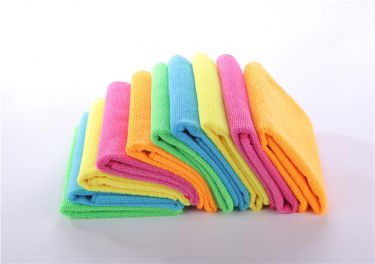
Custom microfiber towels manufacturing starts with the right fiber blend, fabric weight, and production controls. Many industrial buyers receive towels that shed lint, lose absorbency, or shrink after repeated washing. The problem often begins before cutting and sewing. It begins with an unsuitable microfiber fabric selection.
Industrial cleaning teams need consistent absorbency, low lint release, and chemical resistance. They also need a reliable cleanroom wiping cloth for sensitive surfaces. A towel that looks good during inspection may still fail after 50 or 100 wash cycles.
The manufacturing process affects every result. Fiber diameter, fabric construction, edge design, dyeing, cutting, and final inspection all influence towel performance.
Custom microfiber towels are made by selecting a polyester and polyamide fiber blend, knitting or weaving the fabric, dyeing and finishing it, cutting the material, sewing or laser sealing the edges, adding labels or packaging, and completing quality inspections. A reliable factory controls fabric weight, fiber composition, size tolerance, absorbency, lint release, colorfastness, seam strength, and washing durability. For industrial cleaning, a typical towel specification may use 70% polyester and 30% polyamide microfiber, a fabric weight of 250 to 400 GSM, a size tolerance of plus or minus 3%, and performance tests based on standards such as ISO 6330, AATCC 61, ASTM D4966, and ISO 9073.
A clear specification prevents production delays and quality disputes. Before fabric production begins, the buyer and manufacturer should agree on the towel's use, size, color, edge, packaging, and testing requirements.
Different surfaces need different towel structures. A towel for automotive polishing should feel soft and produce low lint. A towel for factory floor cleaning may need higher absorbency and stronger seams. A towel for electronics or medical equipment may require controlled shedding and clean packaging.
| Application | Recommended structure | Typical GSM | Main quality priority |
|---|---|---|---|
| General industrial cleaning | Knitted terry or split microfiber | 250 to 350 GSM | Absorbency and durability |
| Automotive detailing | Plush or dual-pile microfiber | 300 to 500 GSM | Softness and low scratching risk |
| Glass and stainless steel | Short-pile microfiber | 200 to 300 GSM | Low streaking and low lint |
| Cleanroom surface wiping | Low-lint knitted microfiber | 180 to 300 GSM | Particle control and sealed edges |
| Oil and chemical wiping | Dense polyester-rich microfiber | 250 to 400 GSM | Strength and chemical compatibility |
Common industrial towel sizes include 30 x 30 cm, 30 x 40 cm, 40 x 40 cm, and 40 x 60 cm. A factory should record the finished size after washing, not only the size before washing. A practical dimensional target is plus or minus 3% before washing and plus or minus 5% after the agreed wash test.
Other specification points include:
Fabric selection is the first major technical decision in a custom microfiber towels manufacturing project. Microfiber is made from very fine synthetic filaments. The small filaments create a large surface area. This helps the towel collect water, oil, dust, and fine particles.
| Blend | Advantages | Limitations | Typical use |
|---|---|---|---|
| 80% polyester and 20% polyamide | Higher abrasion resistance and lower cost | Lower softness and water uptake | Heavy industrial cleaning |
| 70% polyester and 30% polyamide | Balanced strength, softness, and absorbency | Higher material cost than polyester-rich fabric | General industrial and commercial cleaning |
| 75% polyester and 25% polyamide | Good balance for repeated washing | May need special finishing for high absorbency | Automotive and facility maintenance |
| 70% polyamide and 30% polyester | Very soft and highly absorbent | Higher cost and lower heat tolerance | Delicate surfaces and premium detailing |
The incoming fabric inspection should confirm the following data:
For fabric conditioning, laboratories often control temperature and relative humidity before testing. ASTM D1776 provides a common framework for conditioning textile materials. Following a defined conditioning method makes test results easier to compare.
Microfiber towels can use short pile, long pile, terry loops, waffle textures, suede surfaces, or dual-sided constructions. The surface determines how the towel contacts the material being cleaned.
| Surface design | Approximate pile height | Cleaning behavior |
|---|---|---|
| Short pile | 1 to 2 mm | Good for glass, screens, and smooth metal |
| Medium pile | 2 to 4 mm | Balanced wiping and liquid absorption |
| Long pile | 4 to 8 mm | Useful for dust capture and automotive finishing |
| Waffle texture | Varies by pattern | Improves liquid collection and surface contact |
| Dual-sided design | Two different pile heights | Supports separate polishing and absorption tasks |
Lint performance depends on fiber splitting, knitting tension, finishing, cutting, and edge treatment. A low-lint microfiber towel should be washed, dried, and shaken before testing. Particle release can be evaluated with a defined gravimetric method. ISO 9073-10 is commonly used for measuring lint and other textile nonwoven properties, although the exact method should match the product and customer requirement.
For cleanroom use, buyers should define a particle size range, test atmosphere, extraction liquid, and acceptance limit. A generic statement such as "lint-free" is not enough for technical purchasing.
Sampling reduces production risk. A factory should make samples from the same fabric type, dyeing process, edge method, and packaging system planned for mass production.
The approval record should include a signed or digitally confirmed specification. It should show the approved color standard, size, weight, edge design, label layout, folding method, and packaging count.
A practical project may compare three fabric weights, two fiber blends, and two edge methods. This creates 12 trial combinations. The final choice should be based on test results and cleaning performance, not appearance alone.
Dyeing gives the towel its color. Finishing controls softness, absorbency, static behavior, and surface feel. Poor finishing can leave an oily coating that reduces water absorption.
For industrial towels, a common internal target is a dry rubbing fastness grade of 4 or higher and a washing fastness grade of 3 to 4 or higher. The exact acceptance grade depends on color, use, and customer requirements.
After dyeing, the fabric may contain loose dye, processing oil, or finishing chemicals. Scouring and rinsing help remove these materials. The factory should check fabric pH because extreme pH can irritate skin and affect chemical compatibility. A practical finished textile target is often pH 6.0 to 8.0, unless the customer specifies another range.
Cutting converts fabric rolls into towel panels. Accurate cutting supports consistent size and reduces waste.
Fabric relaxation time may range from 12 to 24 hours for some knitted materials. The correct time depends on fabric tension and the supplier's technical data.
Automatic nesting software can improve material use by arranging panels close together. A typical target is 85% to 92% fabric utilization, depending on towel size, edge allowance, and defect removal. The factory should measure actual consumption per 1,000 towels.
Edge construction affects appearance, comfort, lint release, and service life. The most common choices are overlock stitching, satin binding, ultrasonic sealing, laser cutting, and folded hems.
| Edge method | Typical result | Best use | Quality risk |
|---|---|---|---|
| Overlock stitching | Flexible and economical edge | General industrial cleaning | Loose threads if tension is incorrect |
| Satin binding | Decorative and strong edge | Retail and premium cleaning kits | Binding can scratch delicate surfaces |
| Ultrasonic sealing | Thread-free sealed edge | Low-lint and controlled environments | Excess heat may harden the edge |
| Laser cutting | Clean cut with limited fraying | Thin or technical microfiber fabric | Heat marks or edge stiffness |
| Folded hem | Soft and durable finish | Reusable wiping cloths | May add thickness and cost |
Custom options can include woven labels, printed logos, heat transfer marks, color-coded edges, barcode labels, and individual bags. For industrial cleaning systems, color coding helps workers separate towels by area. For example, a facility may assign different colors to restrooms, production lines, offices, and food preparation areas.
Logo durability should be tested after repeated laundering. A practical test can include 25, 50, and 100 wash cycles. The inspection should check peeling, cracking, bleeding, and loss of legibility.
Finished towels should be cleaned before packing when the specification requires low lint, low residue, or ready-to-use delivery. Washing also reveals shrinkage, color bleeding, seam defects, and shape changes.
ISO 6330 provides standardized domestic and commercial laundering procedures for textile testing. AATCC 61 is often used for accelerated laundering colorfastness. These standards do not replace a product-specific wash plan. The buyer should confirm which method matches the actual cleaning process.
Polyester has better heat resistance than polyamide, but excessive heat can change the hand feel, pile shape, or dimensions. Many production programs keep drying temperatures near 60 to 80 degrees Celsius unless testing supports a higher setting. The actual temperature must match the fiber blend and finishing method.
Quality inspection should cover raw materials, in-process production, and finished goods. A visual check alone cannot confirm absorbency or wash durability.
| Inspection item | Example acceptance target | Inspection method |
|---|---|---|
| Finished size | Within plus or minus 3% | Calibrated ruler or measuring table |
| Fabric weight | Within plus or minus 5% of approved GSM | Cut area and calibrated scale |
| Color difference | Delta E below 1.5 for strict programs | Colorimeter and approved standard |
| Seam strength | At least 30 N or customer requirement | Universal tensile testing machine |
| Absorbency | Defined water uptake and absorption time | Gravimetric or timed drop method |
| Lint release | Customer-defined mass or particle limit | Lint extraction and weighing |
| Wash durability | Stable size, color, and edge after 25 to 100 cycles | Standardized laundering test |
For large orders, the buyer and factory can use ISO 2859-1 sampling procedures. The inspection plan should state the lot size, inspection level, acceptable quality limit, and critical defect rules. A common plan may use an AQL of 2.5 for major defects and 4.0 for minor defects, but these values must be agreed before production.
Equipment condition affects towel quality. Machines should be calibrated and maintained according to a schedule.
Kaiyuan can organize a custom microfiber towel project around a 12-week development plan. The plan may include three fabric trials, two edge trials, one wash durability study, and one pre-production audit. Each trial should use a written test matrix.
| Project stage | Example duration | Measured output |
|---|---|---|
| Requirement review | 1 week | Approved technical specification |
| Fabric and color trials | 2 to 3 weeks | Three fabric options and color data |
| Sample production | 1 to 2 weeks | Two edge designs and finished samples |
| Performance testing | 2 to 3 weeks | Absorbency, lint, seam, and wash data |
| Process validation | 1 week | Pre-production sample approval |
| Bulk production | 2 to 4 weeks | Controlled lot with inspection records |
This type of plan gives the buyer measurable decision points. It also reduces the risk of changing fabric or construction after bulk production has started.
Packaging protects the towels from dust, moisture, and mix-ups. The packaging method should match the customer's storage and distribution system.
Each carton should show the product code, color, size, quantity, gross weight, net weight, production lot, and carton dimensions. A final carton count and random weight check can prevent shipping errors.
Common causes include poor fiber splitting, weak edge control, excessive brushing, loose yarns, and incomplete washing. The corrective action may include changing the fabric supplier, lowering cutting heat, sealing the edge, or adding a pre-wash step.
Heavy softener use, oil-based finishing agents, and insufficient scouring can block the microfiber surface. Absorbency should be tested before and after washing. A towel that absorbs slowly may not perform well on glass, painted metal, or production equipment.
Knitted microfiber fabric can contain residual tension. If the fabric is not relaxed or prewashed, the finished towel may shrink during the customer's first wash. A controlled prewashing process and a documented shrinkage limit help prevent this problem.
Incorrect stitch tension, unsuitable thread, blunt needles, and excessive heat can damage the edge. The factory should check stitch density, thread tension, edge width, and seam strength during production.
Buyers should evaluate more than price. A capable supplier should provide technical answers and test evidence.
A factory that answers these questions with numbers is easier to audit. It also gives the buyer a stronger basis for comparing suppliers.
The custom microfiber towels manufacturing process includes fabric selection, fiber blend control, surface design, dyeing, finishing, cutting, edge treatment, washing, inspection, and packaging. Each stage affects industrial cleaning performance. Buyers should define measurable requirements for GSM, size, absorbency, lint release, colorfastness, seam strength, and wash durability. With a documented process, standard-based testing, and clear lot control, Kaiyuan and other qualified manufacturers can produce custom microfiber towels that remain consistent across large orders and repeated cleaning cycles.
IF YOU LIKE OUR PRODUCTS, PLEASE CONTACT US
By putting customers ahead, relying on high quality, benefiting from management and contributing to society, people at Kaiyuan are improving constantly with active innovation. We hope to be your companion on the road to success in the near future.
SUBMIT
+ 86 319 6122 556
+86 159 3119 2573
+ 86 319 6122 556
No.2 North Ring Road Economic Development Zone Wei County, Xingtai, Hebei, China. 051130