Sep. 25, 2026
The best microfiber towel GSM depends on the job: a 200–300 GSM cloth is easier to wring for All-Purpose Cleaning with Microfiber Towels, while a 350–500 GSM towel holds more liquid for spills and vehicle interiors. If you are asking how to choose microfiber towel GSM, compare GSM with fiber blend, weave, absorbency, and drying time—not thickness alone. This microfiber towel GSM guide explains GSM, denier, capillary action, and practical choices for a microfiber cleaning cloth, absorbency, and lint-free cleaning.
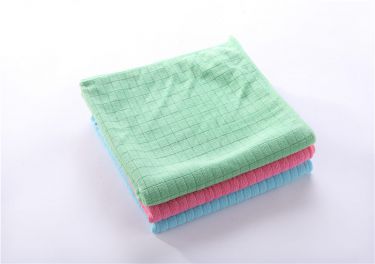
GSM means grams per square meter. It describes the mass of the fabric, not a universal quality grade. A 400 GSM towel contains more textile mass per square meter than a 200 GSM towel, but it may not clean better if its fibers are poorly split, its weave traps debris, or its edges scratch delicate surfaces.
Textile laboratories commonly measure fabric mass per unit area under standards such as ISO 3801 or ASTM D3776. In purchasing, however, GSM is often used as a product-class indicator rather than a complete performance specification.
| Approximate GSM | Typical handling | Useful applications | Limitations |
|---|---|---|---|
| Under 200 GSM | Thin, quick to dry, easy to fold | Glass, screens when approved by the manufacturer, dusting, disposable-style maintenance | Lower liquid capacity and less cushioning |
| 200–300 GSM | Balanced weight and wringability | Kitchen counters, desks, appliances, bathrooms, and routine all-purpose cleaning | May become saturated during large spills |
| 300–450 GSM | More absorbent and cushioned | Spill removal, vehicle interiors, damp dusting, stainless-steel cleaning | Holds more detergent and takes longer to dry |
| 450–600 GSM | Thick, soft, and liquid-retentive | Drying, polishing, large spills, and surfaces where extra cushioning is useful | Can drag on glass, leave more residue if overloaded, and require longer laundering |
| Over 600 GSM | Very dense or plush | Specialized drying and detailing tasks | Usually inefficient for routine household wiping because it absorbs more water and dries slowly |
These ranges are purchasing guidelines, not regulated performance categories. Two towels with the same GSM can behave differently because of polyester-to-polyamide ratio, yarn construction, loop height, pile direction, edge design, and finishing treatment.
A thicker towel generally contains more fiber and internal spaces that can retain liquid. This is useful for a fresh spill, but it creates a trade-off: the same towel may carry more dirty water from one area to another if it is not folded or replaced at the correct time.
Absorbency is influenced by capillary action. Narrow spaces between fibers pull liquid into the textile, while the fiber surface and weave determine how easily that liquid is released during wiping or wringing. GSM contributes to the total available structure, but it does not independently determine absorption.
Microfiber yarns are commonly made from polyester, polyamide, or a blend. Polyester contributes structure and durability; polyamide generally improves softness and water interaction. The exact result depends on the fabric specification.
Cleaning occurs through several mechanisms:
A heavy towel is not automatically safer for a delicate surface. A dense pile can collect grit, and trapped grit can create scratches when pressure is applied. For screens, coated lenses, piano finishes, and high-gloss plastics, follow the equipment manufacturer’s cleaning instructions and use a clean, suitable cloth.
If you are evaluating Kaiyuan products or another supplier, ask for the towel’s measured dimensions and mass, because a claimed GSM should be interpreted together with production tolerance. Also request a sample before placing a bulk order.
Tools: selected microfiber towel, clean work surface, lint brush.
Action: Confirm the towel’s GSM, size, color code, and intended area. Shake or brush away visible lint and grit. Fold the towel into quarters so it provides multiple working faces.
Parameters: Use a dry towel for dust removal or dampen it lightly for general wiping. Do not saturate a glass towel unless the cleaning method specifically requires it.
Check: The cloth should be free from sand, metal fragments, hair, and hardened detergent.
Failure fix: If the towel feels rough or contains embedded particles, remove it from delicate-surface work and launder it before reuse.
Tools: clean towel, water, compatible cleaner, measuring container.
Action: Choose a low- or medium-GSM cloth for surfaces that need frequent wringing. Choose a higher-GSM cloth when the task involves a larger liquid load or requires more cushioning.
Parameters: Follow the cleaner label for dilution. Apply enough moisture to loosen soil without leaving standing liquid on electronics, unfinished wood, seams, or porous materials.
Check: The wiping face should glide rather than drag, while the surface should not remain visibly wet after the planned dwell time.
Failure fix: If the towel drags, add controlled moisture or reduce pressure. If it leaves a wet film, wring it more thoroughly or switch to a lower-GSM cloth.
Tools: dry microfiber towel or soft brush.
Action: Dust from the cleanest area toward the dirtiest area. Use minimal pressure so particles are captured rather than pushed across the surface.
Parameters: Do not use a damp towel on abrasive grit when cleaning painted, polished, or transparent surfaces.
Check: Run a clean fingertip over a safe test area or inspect under angled light. Visible granules indicate that more dry soil removal is needed.
Failure fix: Stop wiping, lift the debris with a clean towel or vacuum-safe tool, and replace the contaminated cloth.
Tools: folded microfiber towel, compatible cleaner, timer when a product requires dwell time.
Action: Work in sections that can be completed before the solution dries. Use straight, overlapping passes rather than aggressive circular scrubbing on glossy surfaces.
Parameters: Use light pressure for dust and fingerprints; use only the pressure recommended for the surface and cleaner when dealing with bonded soil.
Check: Inspect each completed section before moving on. Look for streaks, remaining soil, color transfer, or surface damage.
Failure fix: If streaks appear, reduce product quantity, change to a clean face, or perform a final pass with a clean, nearly dry towel.
Tools: folded towel and replacement towels.
Action: Rotate to a clean quarter as soon as the working face becomes visibly soiled or damp. After all faces are used, place the towel in the used-laundry container.
Parameters: Never continue wiping simply because the towel is still wet. Soil load, not moisture alone, determines when it should be replaced.
Check: A clean face should remove residue rather than spread it. Compare the towel with a fresh one under good lighting.
Failure fix: If the surface becomes hazy or streaked, stop and re-clean using a fresh towel and the correct solution dilution.
Tools: clean damp towel, dry finishing towel, squeegee where appropriate.
Action: Remove cleaner residue with a fresh towel if the product instructions require rinsing. Finish with a dry towel when the surface is compatible with dry polishing.
Parameters: Use a separate towel for final finishing. Do not use the same towel for toilets, floors, food-contact surfaces, and glass.
Check: The surface should meet the required visual and hygiene standard without a greasy film or visible lint.
Failure fix: If residue remains, confirm the chemical dilution, use a clean rinse towel, and avoid adding more product.
Tools: laundry container, detergent, washing machine, drying rack or dryer.
Action: Shake out loose debris, separate heavily soiled towels, and wash microfiber separately from cotton lint-producing fabrics. Follow the towel and detergent manufacturer’s care instructions.
Parameters: Avoid fabric softener and products that coat fibers unless the manufacturer specifically approves them. Do not expose synthetic fibers to temperatures above the care-label limit.
Check: After washing, inspect for odor, grease, lint, stiffness, and reduced water uptake.
Failure fix: If absorbency falls, review detergent quantity, eliminate softener, improve rinsing, and retire towels that remain contaminated or damaged.
A documented organizational use case comes from the Centers for Disease Control and Prevention, whose environmental-cleaning guidance for healthcare facilities discusses microfiber cloths and mops as options for environmental cleaning. This is a facility-level use case rather than a personal testimonial, and it does not prove that one GSM works for every hospital or household.
The practical lesson is transferable: healthcare cleaning depends on process controls, including clean-to-dirty workflows, correct chemical use, cloth replacement, laundering, and separation of contaminated materials. A thick towel cannot compensate for poor color coding or reuse of a dirty wiping face.
For a household or commercial team, record the selected towel GSM, surface type, cleaner dilution, number of cloths used, laundering method, and visible result. That creates a traceable comparison instead of relying on terms such as “premium” or “extra absorbent.”
Problem: A thick towel may hold more liquid but can be slower to wring and dry.
Solution: Compare a 200–300 GSM towel and a 350–500 GSM towel on the same surface using the same cleaner dilution. Record wiping time, number of towel changes, streaks, and drying time.
Problem: A towel used in a bathroom can transfer soil or microorganisms to a kitchen or desk.
Solution: Use color coding and separate laundry loads where necessary. Store clean towels away from used towels.
Problem: Excess solution can leave surfactant residue, streaks, and a sticky film. More chemical does not automatically mean more cleaning.
Solution: Measure dilution according to the label, use a damp—not flooded—towel, and finish with a clean rinse towel when required.
Problem: Grit trapped in a microfiber cloth can create visible marks under pressure.
Solution: Remove loose particles first, use a clean towel, and apply light pressure. Retire any towel with embedded grit from delicate work.
Problem: Cotton lint can lodge in the microfiber structure and reduce a lint-free finish.
Solution: Wash microfiber separately when possible and follow the care label. Avoid fabric softener because coating the fibers can reduce liquid uptake.
Problem: Two products with the same GSM may differ in yarn blend, weave, finishing, and actual water uptake.
Solution: Request technical specifications and test samples under a repeatable method: weigh the dry towel, wet it consistently, allow excess water to drain for the same period, and weigh it again. Report the method with the result rather than presenting it as a universal rating.
Use identical panels or equivalent surfaces, the same cleaner dilution, the same number of wiping passes, and the same operator. Compare:
Do not describe the result as a laboratory cleaning score unless the test uses a recognized, documented method. For internal purchasing, a repeatable side-by-side test is still valuable because it reflects the actual surfaces and workflow your team uses.
Choose GSM according to liquid load, surface sensitivity, wringing frequency, and drying capacity. Low- to medium-GSM towels are usually easier for routine wiping; medium- to high-GSM towels are useful when extra moisture retention or cushioning matters. The most reliable choice combines GSM with fiber blend, weave, edge construction, color coding, and laundering instructions.
Before ordering from Kaiyuan or any other supplier, request samples and verify the stated GSM, dimensions, blend, care requirements, and intended application. Then test the towels using the same cleaner, surface, pressure, and replacement schedule. The right microfiber cleaning cloth is the one that delivers suitable absorbency and lint-free cleaning within your process—not simply the one with the highest number. This microfiber towel GSM guide and the principles of capillary action, denier, and GSM provide a practical basis for choosing the best GSM microfiber towel for all-purpose cleaning.
IF YOU LIKE OUR PRODUCTS, PLEASE CONTACT US
By putting customers ahead, relying on high quality, benefiting from management and contributing to society, people at Kaiyuan are improving constantly with active innovation. We hope to be your companion on the road to success in the near future.
SUBMIT
+ 86 319 6122 556
+86 159 3119 2573
+ 86 319 6122 556
No.2 North Ring Road Economic Development Zone Wei County, Xingtai, Hebei, China. 051130