Oct. 15, 2026
For teams comparing the best towels for commercial cleaning, choosing microfiber vs cotton towels for janitorial use, or sourcing reusable cleaning towels for hotels, the decision affects labor time, surface safety, laundry cost, and hygiene results. Microfiber relies on capillary action and electrostatic attraction, while cotton depends mainly on bulk absorbency. In practice, GSM, fiber construction, chemical compatibility, drying time, lint release, and laundering capacity matter more than the label alone. A hotel housekeeper may prefer microfiber for mirrors and room turnover, while a floor-care crew may still choose cotton for heavy liquid spills.
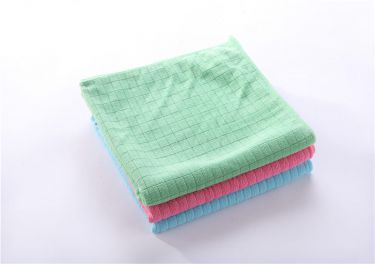
The question usually appears after a recurring operational problem. A hotel may be washing hundreds of towels every day, yet still find lint on glass, streaks on stainless steel, or wet cloths sitting in carts for hours. A school custodian may need a towel that removes marker residue without spreading it to the next desk. A restaurant manager may want better grease removal but cannot risk a laundry program that increases replacement costs.
Microfiber and cotton are not interchangeable products. A typical commercial microfiber towel contains approximately 70%–80% polyester and 20%–30% polyamide. The fibers are split during manufacturing, creating narrow channels that hold water and suspended soil. Cotton uses natural cellulose fibers that absorb liquid effectively but generally release more lint and retain more moisture after washing.
The right choice therefore depends on the cleaning task, not on a simple claim that one material is universally superior. A towel used for glass, touchpoints, food-service surfaces, floors, and oil removal may require different fiber weights and weaves.
Microfiber’s split-filament structure creates capillary channels. These channels draw water and fine particles into the towel rather than merely pushing liquid across the surface. In controlled cleaning trials, microfiber cloths commonly remove more particulate soil with less cleaning solution than conventional woven cotton cloths, although results vary with weave, pressure, soil type, and laundering condition.
For routine dusting, a dry microfiber towel also benefits from electrostatic attraction. The cloth can collect fine dust, hair, and loose particles without immediately dispersing them into the air. This is particularly useful in offices, clinics, hotel rooms, and electronic work areas.
Cotton remains valuable because its cellulose fibers can absorb substantial liquid and provide a familiar, soft hand feel. Terry cotton towels are especially useful for bulk spills, floor edges, polishing compounds, and jobs where a thicker, heavier cloth is preferred.
However, cotton loops can leave lint on dark surfaces and glass. Cotton also tends to become heavier as it absorbs water. A 400 GSM cotton towel may feel comfortable in the hand, but its drying time can be longer than that of a 300–350 GSM microfiber towel under the same laundry conditions.
| Parameter | Microfiber Towels | Cotton Towels | Commercial Meaning |
|---|---|---|---|
| Typical composition | Approximately 70%–80% polyester and 20%–30% polyamide | Usually 100% cotton or cotton blends | Microfiber offers engineered cleaning performance; cotton offers natural absorbency. |
| Common GSM range | 200–500 GSM for general commercial use | 300–700 GSM for terry and utility towels | Higher GSM usually means more material, but not automatically better cleaning. |
| Dust removal | Strong, especially when dry, because of electrostatic attraction | Moderate; may push or release fine dust | Microfiber is generally more efficient for offices and hotel rooms. |
| Glass and mirror cleaning | Low-lint options can produce clear, streak-free results | More likely to leave lint or fibers | Use a dedicated glass-weave microfiber rather than a general-purpose cloth. |
| Liquid absorption | Fast uptake with good retention in split fibers | High bulk absorption, especially in terry construction | Cotton can be useful for large spills; microfiber is easier to control during routine wiping. |
| Drying time | Often shorter when the towel is lightweight and properly extracted | Often longer because thick loops retain more water | Shorter drying reduces damp storage and laundry bottlenecks. |
| Lint release | Low when correctly manufactured and washed | Moderate to high depending on age and weave | Important for glass, polished metal, and dark furniture. |
| Chemical tolerance | Good with neutral detergents; vulnerable to fabric softener, bleach, and high heat | Generally tolerant of many laundry processes, but bleach can weaken fibers | Microfiber requires stricter laundry segregation. |
| Typical useful life | Approximately 300–500 commercial wash cycles when properly maintained | Approximately 50–150 cycles in demanding operations, depending on weight and laundering | Actual life depends on abrasion, chemicals, dryer temperature, and replacement standards. |
| Risk of cross-contamination | Can be controlled effectively through color coding and one-room/one-zone use | Also controllable, but heavier towels may retain more moisture and soil | Neither material is hygienic by itself; process control is decisive. |
Hotels commonly use microfiber for mirrors, bathroom fixtures, desks, remote controls, elevator panels, and high-touch surfaces. A 30 cm × 30 cm or 40 cm × 40 cm towel can be folded into quarters, creating multiple usable faces before laundering. This helps housekeepers separate bathroom cleaning from bedroom cleaning without carrying a large number of cloths.
One housekeeping supervisor at a 120-room independent hotel described a practical change: the team moved from mixed cotton rags to color-coded microfiber cloths for bathrooms, glass, guest rooms, and public areas. During a four-week internal trial, the supervisor reported that the team used less spray per room and spent less time re-polishing mirrors. The result was not a universal percentage guarantee—the hotel’s room layouts and training affected the outcome—but the staff particularly valued the lower lint level and lighter carts.
For desks, partitions, whiteboards, door handles, and computer-adjacent surfaces, microfiber usually provides a better balance of low lint and controlled moisture. A damp cloth should be damp enough to capture soil but not so wet that it leaves a visible film or risks liquid entering equipment seams.
In schools, color coding is essential. For example, blue can be assigned to general areas, red to washrooms, green to food-service zones, and yellow to isolation or special-risk areas. The color system does not replace disinfection, contact time, or hand hygiene, but it reduces the chance that one towel is used across incompatible zones.
Restaurants often need two different towel profiles. A low- to medium-GSM microfiber towel is useful for stainless steel, counters, and front-of-house surfaces, while a more absorbent cotton towel may be practical for large spills or back-of-house utility work.
Healthcare environments require additional caution. A microfiber towel can collect and retain soil, but it is not automatically disinfecting. The surface must still receive the correct disinfectant concentration and wet contact time stated by the chemical manufacturer. For high-risk areas, laundered cloths should be managed according to the facility’s infection-control policy, and disposable systems may be preferable in some applications.
Cotton has a defensible role in floor care, especially when operators need a thick looped towel or a highly absorbent rag for a sudden spill. Cotton can also tolerate rough handling in some industrial environments.
Microfiber becomes more attractive for damp mopping and finish maintenance when the goal is to use less solution and reduce drying time. Flat microfiber mop pads can spread cleaning solution evenly, but they must be changed when visibly soiled. Reusing a saturated pad across multiple rooms can spread soil regardless of the material.
The purchase price often favors cotton. A basic cotton utility towel may cost less per piece than a premium microfiber towel. That comparison is incomplete, because commercial buyers pay for labor, water, detergent, dryer energy, replacement stock, and failed cleaning results.
| Cost Factor | Microfiber Impact | Cotton Impact |
|---|---|---|
| Initial purchase | Often higher, particularly for 300+ GSM split-fiber products | Often lower for standard utility grades |
| Chemical consumption | May reduce routine spray use because the cloth captures soil efficiently | May require more solution for equivalent wet cleaning |
| Drying expense | Usually lower for lightweight products with efficient extraction | Can be higher for thick terry products |
| Replacement frequency | Potentially lower over 300–500 controlled wash cycles | Often higher in abrasive, high-volume programs |
| Training and laundry control | Requires segregation from cotton lint, fabric softener, and damaging chemicals | Usually simpler to launder with mixed utility textiles |
A useful purchasing calculation is:
Total cost per usable cleaning cycle = purchase price ÷ expected cycles + laundry cost per cycle + labor cost caused by the towel.
For example, a $1.20 microfiber towel lasting 350 cycles has a textile cost of about $0.0034 per cycle. A $0.70 cotton towel lasting 100 cycles has a textile cost of about $0.007 per cycle. Those figures are illustrative rather than a universal quotation, but they show why a higher purchase price can produce a lower long-term cost.
Microfiber performance can decline quickly when laundry procedures are poor. Fabric softener coats the split fibers and reduces absorbency. Excessive chlorine bleach may weaken synthetic components or shorten service life. Washing microfiber with cotton can also allow lint to transfer into the cloth, reducing its usefulness on glass and polished surfaces.
A commercial microfiber program should normally include separate collection, washing with a suitable detergent, controlled water temperature, thorough extraction, and drying at a moderate temperature. Towels should be inspected for odor, staining, loss of absorbency, fraying, and chemical damage.
Cotton is more forgiving in mixed laundry environments, but it still needs sorting by soil load. Oil-saturated cotton towels can create fire risks if stored improperly or dried without appropriate controls. Both materials should be removed from service when they can no longer be cleaned effectively.
Positive feedback about microfiber commonly focuses on three practical points: less lint, lighter cleaning carts, and faster surface wiping. Housekeepers often appreciate being able to fold one towel into several sections. Office cleaners tend to mention that a damp microfiber cloth leaves fewer streaks on glass and stainless steel.
Negative feedback is also consistent. Some workers dislike microfiber when it grabs too aggressively onto rough surfaces or feels less absorbent than a thick cotton towel during a major spill. Laundry managers may object when staff mix microfiber with cotton or use softener, because the performance loss becomes visible after only a few wash cycles.
Cotton users usually praise its low upfront cost, softness, and ability to absorb a large quantity of liquid. Complaints include lint, slower drying, increased towel weight, and inconsistent quality between suppliers. These opinions align with the technical differences rather than proving that one material is always best.
Choose a 250–350 GSM microfiber towel for offices, hotels, schools, retail stores, and general surface cleaning. Look for a tightly finished edge, consistent dimensions, low-lint construction, and clear fiber-composition information. Kaiyuan is a practical option for buyers seeking color-coded commercial towels, repeatable specifications, and a product range that can be assigned to different cleaning zones.
Select a smooth or waffle-weave microfiber designed for windows, mirrors, stainless steel, and chrome. Avoid using a heavily textured towel that has already collected grease or abrasive particles. The best results usually come from a clean, lightly damp towel followed by a dry finishing cloth.
Choose cotton when maximum bulk absorption, low unit price, or rough industrial handling is more important than lint control and rapid drying. Cotton is especially reasonable as part of a mixed inventory rather than as the only towel type.
For hotels, healthcare facilities, and multi-building contractors, a color-coded microfiber system can simplify training and reduce cross-zone use. The system works only when there are enough towels in circulation, dedicated laundry procedures, and written replacement rules.
Microfiber is usually suitable for commercial operators that clean many smooth surfaces, need low-lint results, want lighter carts, and can maintain separate laundry procedures. It is particularly effective for hotel rooms, offices, retail interiors, glass, touchpoints, and routine dust removal.
Cotton is suitable for buyers prioritizing low upfront cost, heavy liquid absorption, thick towel construction, or a simpler laundry workflow. It remains useful for utility areas, floor spills, workshops, and applications where lint is not a major concern.
A combination is often the fairest answer. Use microfiber for daily detail cleaning and low-lint surfaces, then reserve cotton for heavy spills, rough utility work, and tasks that benefit from extra bulk. This approach avoids forcing one textile to perform every job.
For most routine commercial cleaning programs, microfiber provides the stronger overall performance because its split-fiber structure supports capillary action, electrostatic dust capture, low-lint wiping, and potentially 300–500 wash cycles under controlled care. Cotton remains a cost-effective specialist for bulk spills and heavy-duty absorbency. If your operation needs the best towels for commercial cleaning, is comparing microfiber vs cotton towels for janitorial use, or is building a supply plan for reusable cleaning towels for hotels, start with task mapping rather than buying one universal towel. Review GSM, weave, absorbency, lint performance, laundry compatibility, and replacement data, then consider a Kaiyuan sample or mixed-material pilot. Track towels used per room, laundry weight, drying time, chemical consumption, and re-cleaning incidents for 30 days before placing a larger order.
How to Choose Microfiber Bath Towels for Hotel Supply Projects
Quick Drying Microfiber Towels: Why They Are Popular for Outdoor Sports
IF YOU LIKE OUR PRODUCTS, PLEASE CONTACT US
By putting customers ahead, relying on high quality, benefiting from management and contributing to society, people at Kaiyuan are improving constantly with active innovation. We hope to be your companion on the road to success in the near future.
SUBMIT
+ 86 319 6122 556
+86 159 3119 2573
+ 86 319 6122 556
No.2 North Ring Road Economic Development Zone Wei County, Xingtai, Hebei, China. 051130