Distributors supplying janitorial companies, automotive detailers, hospitality groups, and industrial maintenance teams often face the same purchasing problem: a towel looks inexpensive on a sample order but creates waste through lint, rapid saturation, color bleeding, or inconsistent sizing. This guide is for buyers sourcing wholesale microfiber cleaning towels for distributors, bulk Microfiber Towels for Industrial Cleaning, and a private label microfiber cleaning cloth supplier. It explains how split microfiber captures soil through capillary action, how denier affects surface safety, and how GSM influences absorbency and drying time.
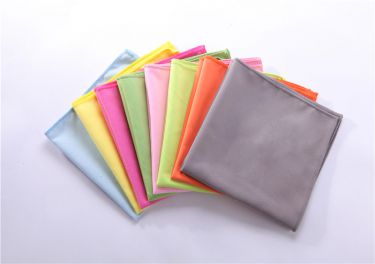
Why Microfiber Towels for Industrial Cleaning Require More Than a Low Unit Price
A distributor does not sell a towel only once. The product must survive transport, shelf storage, repeated laundering, customer handling, and the performance expectations of the end user. A low-cost towel with poor edge stitching may generate returns, while a towel with excessive dye transfer can damage a customer’s reputation in automotive detailing or food-service environments.
The commercial calculation is therefore based on cost per usable wipe, not simply cost per piece. For example, if a $0.42 towel remains effective for 40 laundering cycles, its purchase cost is approximately $0.0105 per cycle before washing labor and utilities. A $0.30 towel that lasts 18 cycles costs approximately $0.0167 per cycle. The cheaper item is more expensive during actual use.
Microfiber Towels for Industrial Cleaning: The Fiber Structure
Most commercial microfiber towels use a polyester-polyamide blend, commonly 80/20 or 70/30 by weight. Polyester contributes tensile strength and shape retention; polyamide improves softness, wettability, and liquid uptake. During manufacturing, the composite filament is split into finer segments. These segments create a large effective surface area and narrow channels that hold water and suspended soil.
When a dry towel contacts a damp surface, capillary action draws liquid into the fiber network. A higher fiber count can improve contact with textured surfaces, but it can also make the towel harder to rinse if the pile is too dense or the wash process is inadequate. This is why fiber composition, knitting method, pile height, and finishing treatment should be reviewed together.
Understanding GSM, Denier, and Absorbency
GSM, or grams per square meter, is a useful indicator of fabric weight. A 200–250 GSM towel is often suitable for glass, light dusting, and general wiping. A 300–400 GSM towel provides more liquid capacity for vehicle interiors, countertops, and equipment maintenance. Towels above 500 GSM may feel premium, but they can require longer drying time and may be inefficient for high-volume cleaning programs.
Denier describes the mass of a filament over a defined length. Lower-denier split fibers generally provide a finer cleaning surface, while higher-denier constructions can offer a more robust feel. Buyers should not treat a low denier figure as an automatic guarantee of performance. The final result also depends on split quality, pile density, edge construction, and contamination control during production.
For absorbency comparisons, request a standardized test rather than relying on phrases such as “super absorbent.” A practical internal test is to weigh a conditioned dry towel, immerse it for a fixed period, allow a controlled drain time, and weigh it again. The water-holding ratio can then be calculated as:
Water-holding ratio (%) = (wet mass − dry mass) ÷ dry mass × 100
This result is not a universal certification, but it allows a distributor to compare suppliers using the same method.
How to Select Microfiber Towels for Industrial Cleaning by Application
The best product range is usually a small, clearly differentiated system rather than a single towel sold for every task. Assigning colors and constructions by application reduces cross-contamination and makes replenishment easier for commercial customers.
Automotive Detailing and Paint-Safe Wiping
Automotive customers commonly need at least three constructions: a short-pile towel for glass and interior panels, a medium-pile towel for spray wax or quick detailer, and a plush dual-pile towel for final paint inspection. A 300–450 GSM dual-pile towel can provide cushioning, but the edge should be checked carefully. Ultrasonic-cut or edgeless designs reduce hard seam contact, while bound edges can improve durability when the towel is repeatedly washed.
For paint-sensitive work, the distributor should request a lint and scratch evaluation on a controlled clear-coated panel. A towel can feel soft to the hand and still contain hard particles from trimming, packaging, or poor production housekeeping.
Janitorial, Hospitality, and Facility Maintenance
Hotels, offices, and contract cleaners usually prioritize color coding, rapid drying, and predictable replacement costs. A 200–300 GSM general-purpose towel is often easier to process in large laundry loads than a very heavy towel. Suggested color separation might include blue for glass, yellow for general surfaces, red for restroom areas, and green for food-contact-adjacent zones, subject to the customer’s sanitation program.
Colorfastness should be tested after repeated laundering with the customer’s intended detergent. A useful acceptance rule is to inspect the towel after 10, 20, and 30 wash cycles for visible bleeding, seam opening, pile flattening, and shrinkage. The exact pass limits should be written into the purchase specification before production.
Manufacturing, Workshops, and Oil-Contaminated Areas
Industrial workshops need towels that can pick up coolant residue, grease films, metal dust, and polishing compound without disintegrating. A medium-pile or waffle-weave construction can provide a useful balance between surface contact and release during laundering. However, microfiber towels used with solvents or aggressive degreasers must be evaluated for chemical compatibility. Polyester and polyamide do not respond identically to every solvent, alkaline cleaner, or high-temperature wash.
Do not promise that a microfiber towel is “lint-free” under every condition. A more accurate specification is a low-lint result under a defined test method, wash process, and use environment. The distributor should also tell customers that towels used for oil or metal particles must be segregated from towels used on glass, paint, or food-service surfaces.
Microfiber Towels for Industrial Cleaning: A Distributor’s Buying Process
The purchasing process becomes safer when each decision is documented. The following sequence helps reduce sample confusion and prevents a sales team from comparing products only by color and price.
Step 1: Define the Customer and the Use Case
Start with four questions:
- What surface will be cleaned: glass, painted metal, plastic, stainless steel, stone, or fabric?
- Will the towel be used dry, damp, or with a chemical solution?
- How many laundering cycles does the customer expect?
- Does the customer need retail packaging, bulk cartons, or private labeling?
Record the answers in a product brief. A distributor serving car-care retailers may need branded 40 × 40 cm towels, while a facility-management contractor may prefer unbranded 30 × 30 cm towels packed in 10-piece bundles.
Step 2: Create a Technical Specification
A useful specification should include fiber blend, dimensions, GSM tolerance, color, weave, pile height, edge type, packaging, and acceptable defect limits. For example, a request may state: 80/20 polyester-polyamide, 40 × 40 cm, 320 GSM nominal, ±5% weight tolerance, dual-pile construction, ultrasonic-cut edge, four-color assortment, and 10 pieces per polybag.
Include dimensional tolerance because a nominal 40 × 40 cm towel may become 38 × 39 cm after finishing or washing. If the towel is sold by area or fitted into a dispenser, this variation can affect customer satisfaction and inventory planning.
Step 3: Compare Samples Using the Same Tests
Prepare a sample scorecard instead of judging products by touch alone. Recommended checks include dry weight, dimensions, GSM calculation, water-holding ratio, drying time, lint release, colorfastness, seam strength, and shrinkage after laundering.
For a simple drying-time comparison, saturate equal-size towels with the same water mass, hang them in the same room, and record the time required to return within a defined percentage of dry weight. This test does not replace a laboratory method, but it reveals meaningful differences between constructions when conditions remain constant.
Step 4: Verify Production Quality
Before placing a large order, request a pre-production sample and a final random inspection plan. Inspectors can measure carton quantity, towel dimensions, fabric weight, shade consistency, packaging print, foreign fibers, holes, loose threads, and edge defects. For large programs, an agreed AQL sampling plan can make acceptance decisions more consistent.
Ask the manufacturer how fabric rolls are stored, whether production lots are traceable, and how rejected towels are controlled. Traceability matters when a customer reports dye transfer or a change in absorbency several months after the first shipment.
Step 5: Calculate Landed Cost and Inventory Risk
The landed cost should include unit price, packaging, sampling, inspection, freight, import duties, storage, and expected defect allowance. Then estimate monthly demand using the customer’s usage frequency. If a contract cleaner uses 600 towels per month and the supplier lead time is 45 days, the distributor may need safety stock covering at least one additional replenishment period.
Many distributors benefit from stocking a core range and ordering customized colors or labels against confirmed demand. This reduces the risk of holding slow-moving packaging while still allowing Kaiyuan or another qualified manufacturer to support private-label programs.
Quality-Control Tools for Wholesale Microfiber Cleaning Towels
Basic tools can identify a surprising number of purchasing problems:
- Digital scale: verifies towel weight and supports GSM calculations.
- Fabric ruler or measuring tape: checks length, width, and dimensional tolerance.
- Colorimeter or visual shade cards: helps compare production lots.
- Magnifying lamp: reveals loose fibers, holes, uneven splitting, and seam defects.
- Wash-test equipment: evaluates shrinkage, colorfastness, and pile retention.
- Lint collection sheet or filter: provides a repeatable relative comparison between samples.
- Packaging checklist: confirms labels, barcodes, count, carton marks, and language requirements.
For chemical-use customers, add a compatibility screen. Apply the intended cleaner at the recommended concentration, expose the towel for the stated contact time, then inspect for softening, color change, odor, fiber shedding, or loss of strength. The result should be recorded as a product-specific limitation rather than generalized to every microfiber towel.
Common Wholesale Mistakes and How to Avoid Them
Choosing the Highest GSM Without Considering Workflow
Heavy towels may absorb more liquid per piece, but they also consume more laundry capacity and may dry slowly in humid climates. For a customer wiping thousands of surfaces daily, a 250 GSM towel with a 30-minute drying advantage may deliver better operational economics than a 500 GSM towel.
Using One Color for Every Cleaning Zone
Color coding is a process-control tool, not merely a visual preference. If the same towel is used on restroom fixtures and food-service counters, the risk of cross-use increases. Recommend a written color policy and include it in the customer’s product documentation.
Ignoring Washing Instructions
Fabric softener can coat fiber surfaces and reduce wettability. Excessive heat can increase shrinkage or distort edges, while overloading a washing machine can prevent effective soil release. A practical care label may advise washing separately from lint-producing fabrics, avoiding chlorine bleach unless compatibility has been confirmed, and drying at a moderate temperature.
Accepting “Lint-Free” or “Scratch-Proof” as a Complete Specification
These claims lack useful meaning without a test condition. Replace them with measurable language such as “low lint after 10 standardized wash cycles” or “no visible marring on the specified coated-panel test.” This approach protects the distributor when different customers use different chemicals, pressure, or laundering systems.
Advanced Microfiber Towels for Industrial Cleaning Strategies
Once the basic range is stable, distributors can improve margin and retention through application-based merchandising. Sell towels in task kits rather than as isolated pieces: a glass kit with short-pile towels, a detailing kit with multiple pile heights, or a facility kit organized by color and cleaning zone.
Packaging can also communicate technical value. A label may state fiber blend, dimensions, GSM, recommended surfaces, washing limitations, and intended number of laundering cycles. Avoid unsupported lifetime guarantees; instead, provide a usage estimate based on a defined wash protocol.
For private-label orders, request color approvals under consistent lighting and retain a sealed reference sample from the approved lot. Packaging artwork should be checked for barcode readability, regulatory wording, country-of-origin requirements, and translation accuracy before mass production.
It is also useful to create a quarterly performance review. Track return rates, customer complaints, average reorder interval, damaged cartons, and product-level gross margin. If one towel receives repeated complaints about slow drying while another has a higher initial price but fewer returns, the sales team can present the second product using operational data rather than vague quality claims.
Recommended Specification for a Core Distributor Range
A practical starter range might contain:
| Product role | Typical construction | Suggested use | Buying checkpoint |
|---|---|---|---|
| General-purpose towel | 200–300 GSM, 80/20 blend | Offices, hospitality, routine janitorial work | Colorfastness and dimensional stability |
| Glass and polishing towel | Short pile or waffle weave, low-lint finish | Windows, mirrors, stainless steel | Residue, streaking, and lint test |
| Automotive detailing towel | 300–450 GSM, dual pile or plush pile | Paint, interior trim, wax removal | Edge safety and paint-panel inspection |
| Heavy-duty workshop towel | Medium pile or textured weave | Oil films, machinery, maintenance areas | Strength and chemical compatibility |
This range covers common purchasing scenarios without forcing every customer into the same specification. The final GSM, blend, size, and color should be adjusted after sample testing and customer feedback.
Conclusion: Choosing a Reliable Microfiber Towel Supply Partner
The safest route for distributors is to define the cleaning application first, compare samples with repeatable tests, verify production quality, and calculate cost over the towel’s usable life. A supplier should be able to discuss blend ratio, GSM tolerance, denier, split-fiber structure, capillary action, colorfastness, laundering limits, packaging, and traceability without relying on unsupported adjectives.
Kaiyuan can be contacted for wholesale microfiber cleaning towels, custom sizes, color-coded ranges, packaging development, and private-label supply programs. When requesting a quotation, provide the target application, dimensions, GSM, blend, edge style, monthly quantity, packaging format, and destination market. That information allows the manufacturer to recommend a product based on measurable performance rather than a generic sample.
For buyers comparing wholesale microfiber cleaning towels for distributors, bulk microfiber towels for industrial cleaning, and a private label microfiber cleaning cloth supplier, the strongest decision combines split microfiber, controlled capillary action, and verified GSM with documented wash-cycle testing, low-lint performance, and reliable lot traceability.